The Ultimate Icon: A Deep Dive into the Hermès Birkin 40 in Ardoise Togo with Palladium Hardware
In the upper echelons of luxury fashion, few objects command the universal reverence, fascination, and economic status of a Hermès Birkin. More than just a handbag, the Birkin is a cultural touchstone, a masterclass in artisanal craftsmanship, and a legendary fixture of modern investment portfolios. Among the vast taxonomy of sizes, leathers, and metal finishes that Hermès has produced over the decades, specific configurations stand out as hidden masterpieces or quintessential powerhouses.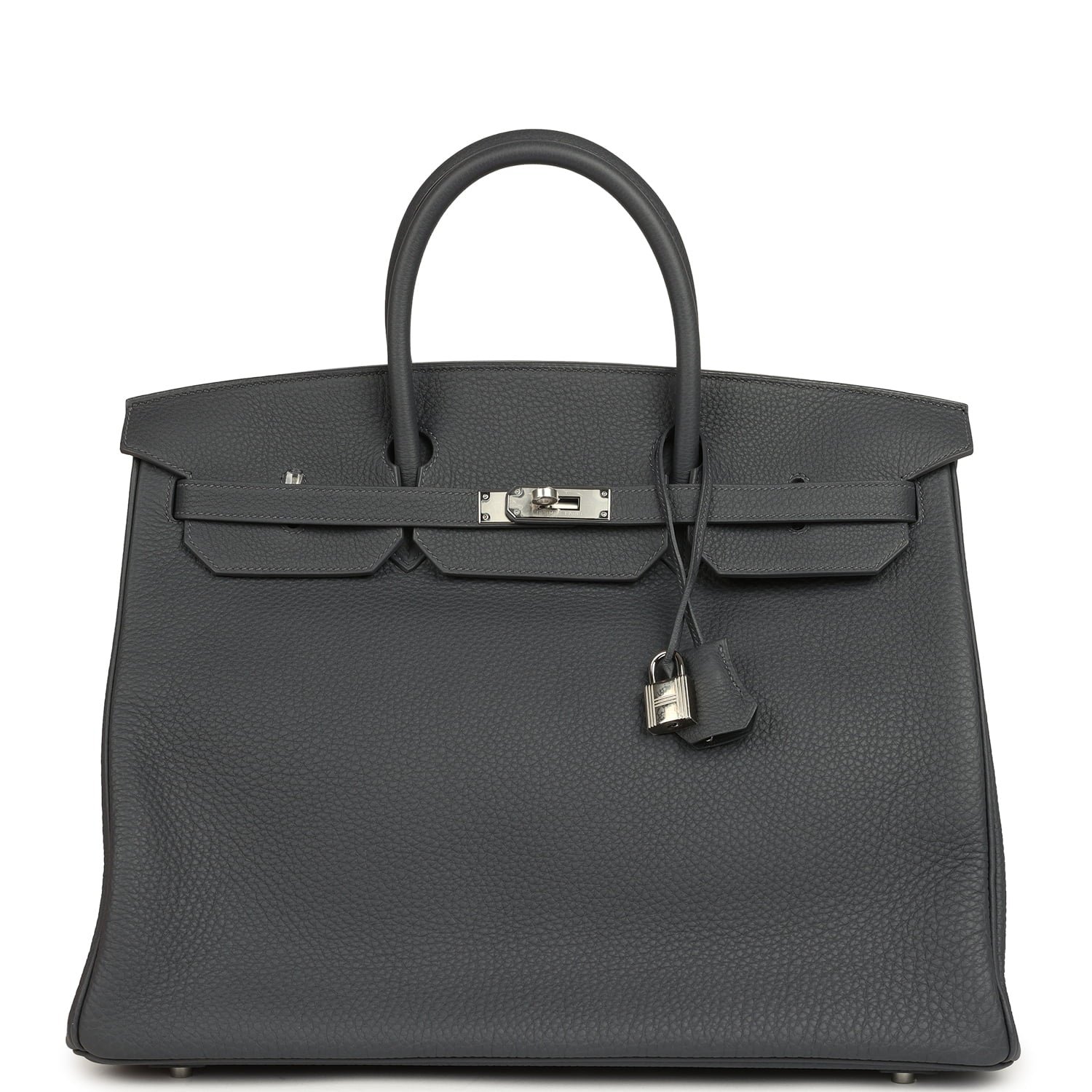
Enter the Hermès Birkin 40 in Ardoise Togo Leather with Palladium Hardware (PHW).
While smaller proportions like the Birkin 25 and 30 have dominated the mainstream conversation for everyday fashion over the last decade, the Birkin 40 represents the true roots of the design, marrying monumental scale with understated luxury. Coupled with Ardoise—a sophisticated, slate-gray neutral—and the crisp, modern brilliance of palladium hardware, this specific configuration is a masterclass in quiet elegance.
1. The Heritage of Scale: Understanding the Birkin 40
To truly appreciate a Birkin 40, one must look back at its lineage. Created in 1984 following a fateful mid-air encounter between actress Jane Birkin and Hermès Chief Executive Jean-Louis Dumas, the original bag was conceived to answer the practical needs of a young mother and style icon who needed something larger, more structured, and more functional than a traditional handbag.
While the 25cm and 30cm variants are often worn as delicate city bags or evening accessories, the Birkin 40 is the grand original proportion. It is a bold, substantive piece that serves as an exceptional travel companion, a high-end briefcase, or a statement daily carry-all.
Dimensions: Measuring approximately 40 cm in width, 30 cm in height, and 21 cm in depth, with a generous handle drop, it provides an expansive interior capable of housing laptops, documents, travel essentials, and daily necessities.
Presence: Carrying a Birkin 40 requires confidence. It subverts the trend of micro-bags, projecting an air of unapologetic utility, timeless authority, and classic luxury.
2. The Materiality: The Indomitable Appeal of Togo Leather
The choice of leather defines not only the tactile experience of a Hermès bag but also its structural integrity and longevity. For a bag of the Birkin 40’s scale, Togo leather is widely considered the gold standard.
Introduced by Hermès in 1997 and named after the African nation, Togo leather is crafted from baby calf hides (veau Togo). It is renowned for several defining characteristics:
The Grain: Togo features a distinct, prominent, small rounded grain (known as grain rond). When inspected closely, faint natural veining (triage) can often be seen, testifying to the organic authenticity of the hide.
Scratch and Scuff Resistance: Unlike smoother box calf or delicate swift leathers, Togo is exceptionally resilient. Its textured surface naturally masks minor scratches or daily wear, making it an ideal choice for a larger bag meant to be actively used.
Structure and Slouch: Togo possesses a wonderful natural stiffness that allows a Birkin 40 to maintain its architectural boxy silhouette when new. Over time, however, as the fibers relax, it develops a luxurious, supple slouch—a characteristic that seasoned collectors deeply prize, as it gives the bag a "lived-in" elegance without losing its form.
Weight Profile: While a Birkin 40 is inherently substantial due to its physical size, Togo leather strikes an optimal balance, offering a lighter carrying experience compared to heavier hides like Clemence, while remaining significantly sturdier than Epsom.
3. The Color Palette: The Sophistication of Ardoise
Color is where Hermès demonstrates its unparalleled mastery of dye chemistry and storytelling. Ardoise—the French word for slate—is a mesmerizing, sophisticated neutral that sits gracefully within the gray family, yet possesses unique chromatic depth.
Many neutral bags lean strictly into stark black (Noir), stark white (Blanc), or warm browns (Gold). Ardoise offers something far more nuanced:
The Chameleon Effect: Ardoise is a moody, atmospheric gray with subtle undertones of cool blue and deep charcoal. Depending on the lighting—whether under harsh fluorescent office lights, warm interior lamps, or natural midday sun—the color shifts subtly, revealing its complex slate character.
Versatility: Unlike warmer taupes or stark blacks, Ardoise acts as an ultimate chameleon in a wardrobe. It pairs impeccably with crisp white linens, navy tailoring, monochrome black ensembles, and rich jewel tones like burgundy or forest green.
Understated Luxury: Gray is the ultimate hallmark of quiet luxury. It conveys a sophisticated, intellectual restraint. An Ardoise Birkin does not scream for attention; instead, it draws the eye through its sheer refinement and rarity on the secondary market.
4. Hardware Details: The Modern Edge of Palladium
The metal hardware on a Hermès bag acts as its jewelry. On this configuration, the use of Palladium Hardware (PHW) provides a striking visual counterpoint to the deep, muted slate of the Ardoise Togo leather.
What is Palladium? Palladium is a rare, lustrous silvery-white precious metal belonging to the platinum group. Unlike standard plated metals, palladium is naturally corrosion-resistant, highly durable, and retains its brilliant mirror-like shine for decades without easily tarnishing.
Aesthetic Harmony: While gold hardware (Gouverneur or Permabrass) imparts a warm, traditional, and opulent vintage vibe, palladium hardware brings a sleek, contemporary, and architectural edge. Against the cool undertones of Ardoise leather, palladium looks crisp, modern, and razor-sharp.
The Iconic Mechanics: The hardware suite includes the signature sangles (straps), the central turn-lock (fermoir), the padlock (cadenas), the keys tucked securely within the leather clochette, and the four metal feet (clou de pieds) designed to protect the base of the bag when set down. Every component is meticulously engraved with the Hermès signature and assembled with microscopic precision.
5. Craftsmanship: The Hand of the Artisan
No discussion of a Hermès Birkin is complete without acknowledging the legendary craftsmanship behind its creation. Every single Birkin is entirely handmade by a single artisan in the ateliers of France—a process that can take anywhere from 18 to 25 hours of intense labor.
The Saddle Stitch: Utilizing the traditional two-needle saddle stitch technique—which cannot be replicated by any sewing machine—the artisan ensures that even if a thread were to break over years of use, the stitch will not unravel.
Edge Dyeing and Polishing: The edges of the Togo leather panels are meticulously painted, dried, and polished by hand multiple times to ensure a seamless, waterproof, and velvety finish.
The Blind Stamp: Discreetly embossed on the leather strap interior, the artisan's stamp, workshop code, and year letter signify the bag's provenance, serving as an unalterable passport of authenticity.
6. Investment, Utility, and the Modern Collector
In the contemporary luxury landscape, the Birkin 40 occupies a fascinating space. While smaller bags dominate trend-focused purchases, the Birkin 40 remains the definitive choice for the true connoisseur, frequent traveler, and serious collector.
Market Dynamics: Because Hermès produces strict, undisclosed quotas and boutique allocations are exceptionally difficult to secure—requiring significant prior purchase history—Birkins maintain extraordinary value retention on the secondary market. Neutral colors like Ardoise, paired with durable Togo leather and palladium hardware, represent some of the most liquid and sought-after assets in luxury resale.
A Gender-Fluid Power Piece: The Birkin 40 has increasingly become a favorite across all demographics, serving as an exceptional men's luxury travel bag or daily briefcase, offering immense capacity without compromising an ounce of style.
Conclusion
The Hermès Birkin 40 in Ardoise Togo with Palladium Hardware is far more than an accessory; it is an enduring investment in the pinnacle of human craftsmanship. It bridges the gap between historical utility—tracing its lineage back to equestrian saddle bags—and modern, metropolitan sophistication. With its resilient Togo texture, its moody, intelligent Ardoise hue, and the razor-sharp brilliance of palladium, it stands as a monument to timeless style, proving that true luxury never shouts—it merely exists in a class of its own.


Comments
Post a Comment