The Pinnacle of Haute Horlogerie and Leathercraft: Unpacking the Hermès Kelly Sellier 20 in Vert Jade Shiny Alligator with Gold Hardware
In the upper echelons of luxury fashion, certain artifacts transcend their functional origins to become cultural and economic milestones. Among these, few objects hold the commanding presence, mythological scarcity, and uncompromising craftsmanship of a rare Hermès handbag. Within the pantheon of Hermès masterpieces, the Hermès Kelly Sellier 20 in Vert Jade Shiny Alligator with Gold Hardware—frequently referred to by collectors as the Mini Kelly II Sellier—represents an absolute summit.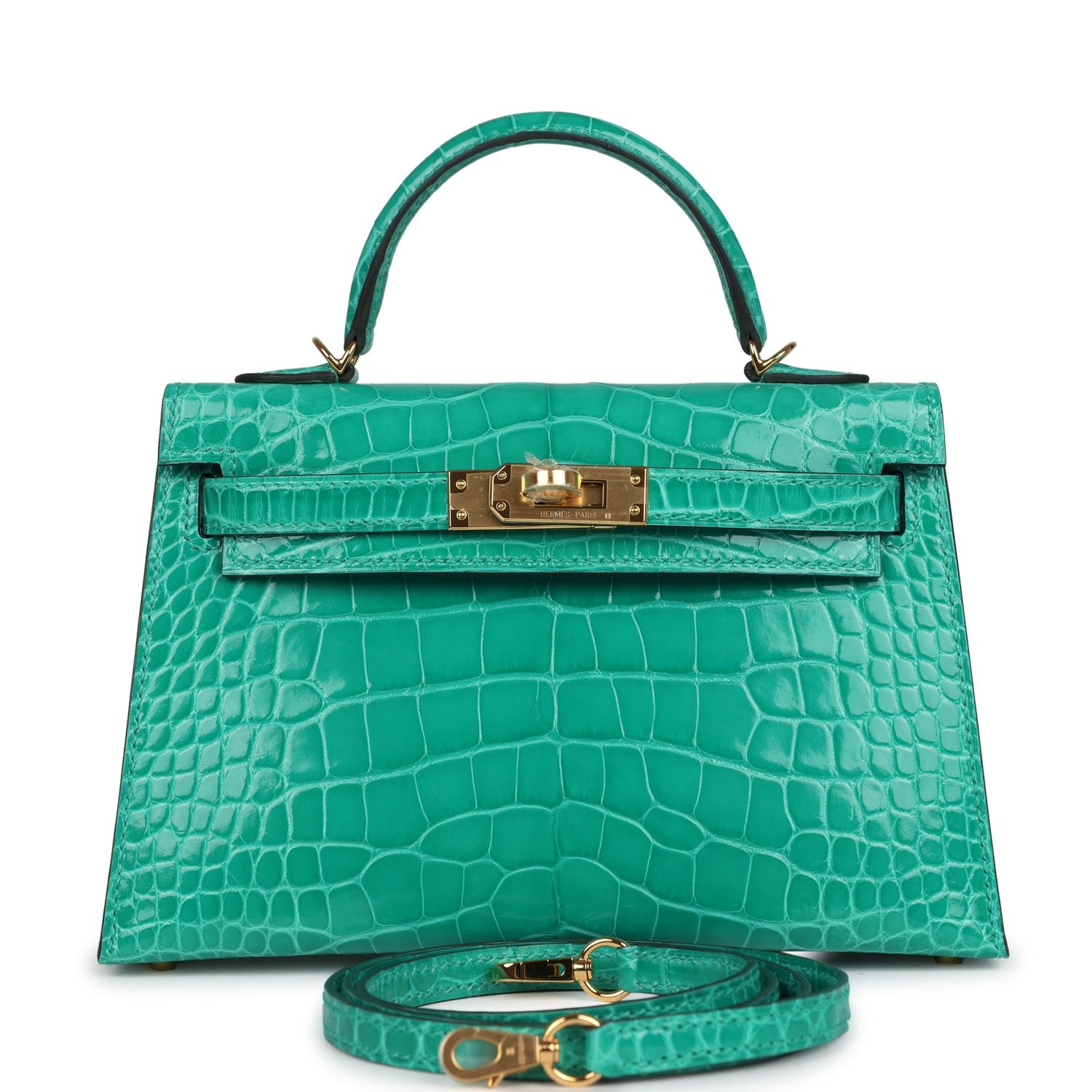
This specific configuration is not merely an accessory; it is a convergence of haute leathercraft, botanical-inspired color theory, and elite material sourcing. To understand why this precise combination commands global reverence and astronomical secondary-market valuations is to explore the intersection of art, architecture, and enduring legacy.
1. The Anatomy of an Icon: The Kelly Sellier 20
To appreciate the Kelly 20, one must first look back at its lineage. Originally introduced as the Sac à dépêches in the 1930s and later renamed in honor of Grace Kelly, Princess of Monaco, in 1956, the Kelly bag is defined by its trapezoidal geometry, single top handle, and meticulous saddle-stitching.
The Kelly is historically produced in two primary construction styles: Retourné and Sellier.
The Retourné is sewn inside out and then flipped, resulting in a softer, more relaxed silhouette with rounded, piped edges.
The Sellier, by contrast, is the structural purist’s dream. Built with external stitching and exposed resin-coated edges (crassat), the Sellier construction forces the leather to maintain a rigid, sharp, architectural form.
At a miniature scale—specifically the Kelly 20 (often colloquially dubbed the Mini Kelly II)—the Sellier construction takes on breathtaking proportions. Measuring roughly 7.5 inches in width, 4.5 inches in height, and 2.2 inches in depth, the Mini Kelly Sellier transforms from a utilitarian tote into a jewel-like micro-structure. The rigid lines of the Sellier build give the petite bag an upright, commanding posture. Every angle is crisp, every plane is flat, and the structural integrity relies entirely on the artisan's ability to tension the leather and thread uniformly without warping the frame.
2. The Exotic Standard: Mississippiensis Alligator and Lisse Finish
While Hermès crafts bags in various leathers ranging from everyday calfskins like Togo and Epsom to exotic skins like niloticus crocodile and porosus crocodile, American alligator (Alligator Mississippiensis) occupies a uniquely coveted space.
For the Vert Jade Kelly 20, Hermès utilizes premium alligator hide characterized by small, uniform, rectangular belly scales flanked by softer, rounded flank scales. Sourcing these skins requires adherence to strict global conservation regulations, including CITES (Convention on International Trade in Endangered Species) certification, ensuring ethical and sustainable harvesting.
What elevates this specific piece is the Shiny (Lisse) finish. Achieving a high-gloss finish on alligator skin is an arduous, multi-week undertaking:
The Polishing Process: The artisan utilizes a genuine agate stone—a dense, smooth mineral—to manually buff the surface of the leather under immense pressure.
Friction and Luster: This friction melts and flattens the natural oils within the scales, creating a mirror-like sheen that catches and refracts light from every conceivable angle.
Tactile Contrast: Unlike matte alligator, which feels subtle and organic, shiny alligator is luminous, dramatic, and intensely vibrant. It demands attention, acting almost as a liquid metal or a polished gemstone resting against the wearer’s hand.
3. Vert Jade: A Masterclass in Hermès Color Theory
Color is the lifeblood of the Hermès house. The French atelier introduces, retires, and reinvents hues with the precision of a fine art academy. Vert Jade (Jade Green) is widely celebrated as one of the most sophisticated, complex greens ever formulated by Hermès colorists.
Inspired by the mineral jade—a stone historically associated with nobility, purity, and eternity in Eastern cultures—Vert Jade is neither a harsh emerald nor a muted olive. Instead, it exists in a breathtaking equilibrium:
It possesses deep, earthy undertones that anchor its maturity.
It radiates vibrant, aquatic blue-green flashes when exposed to direct sunlight.
When translated onto shiny alligator, Vert Jade undergoes a profound transformation. The high-gloss finish deepens the color’s saturation, allowing the lighter centers of the alligator scales to create a natural, three-dimensional gradient effect (often referred to in the luxury community as "chatoyancy"). The color appears alive, shifting dynamically from a deep forest moss in dim interiors to a glowing, translucent jewel tone outdoors.
4. Warmth and Authority: Polished Gold Hardware (GHW)
The hardware on an Hermès bag—comprising the iconic touret (turn-lock), sangles (straps), plaques, four base feet, and the mechanical padlock—is crafted with the same precision as fine jewelry. For the Vert Jade Shiny Alligator Kelly 20, the pairing with Gold Hardware (GHW) is a masterstroke of traditional styling.
While Palladium (silver-tone) hardware offers a modern, cool, and minimalist aesthetic, 18k gold-plated hardware introduces an unmistakable sense of heritage, warmth, and opulence.
The Visual Synergy: Green and gold form one of nature's most regal pairings, echoing the historic splendor of imperial art, botanical manuscripts, and royal regalia. The golden yellow undertones of the hardware complement the rich, vibrant warmth of the Vert Jade alligator skin, enhancing its depth rather than competing with it.
The Details: Every piece of hardware is engraved with microscopic precision. Even the tiny screws securing the plates inside the bag feature slots meticulously aligned horizontally—a hallmark of Hermès perfectionism. The contrast of polished gold against the high-gloss green scales elevates the piece from a simple handbag to an heirloom-quality treasure.
5. The Art of the Hermès Artisan: Craftsmanship and Time
To fully value a Kelly Sellier 20 in exotic leather, one must understand the human element behind its creation. Unlike mass-market luxury goods produced on assembly lines, every single Hermès bag is constructed from start to finish by a single artisan.
An artisan train at the École Hermès des Savoir-Faire for years before being permitted to touch exotic skins, which are notoriously difficult to cut, align, and stitch.
Book-matching: For an exotic Kelly, the artisan must meticulously "book-match" the alligator scales, ensuring that the pattern on the front panel mirrors itself symmetrically from the center seam outward. This requires exceptional spatial awareness and material waste management.
Saddle Stitching: Utilizing traditional linen thread coated in beeswax, the artisan executes the double-needle saddle stitch by hand. If a single stitch is irregular, the entire panel must be undone and restarted.
Edge Painting: The raw edges of the Sellier frame are meticulously painted, dried, and sanded across multiple layers to achieve a seamless, glass-like seal that withstands decades of handling.
This dedication to craft means that the production volume of shiny exotic Kelly bags is minuscule. Most clients wait years across multiple purchase cycles with their local boutique just to be offered a standard leather Kelly, making exotic editions like the Vert Jade Alligator virtually impossible to secure at retail.
6. Cultural Phenomenon and Investment Landscape
In contemporary culture, the Mini Kelly Sellier has evolved far beyond its functional purpose. It is a dominant fixture on red carpets, international fashion weeks, and the arms of elite collectors, tastemakers, and royalty. Its diminutive size aligns with the modern micro-bag movement, yet its historical pedigree ensures it never feels like a fleeting trend.
From an investment perspective, rare Hermès exotics have consistently outperformed traditional asset classes, including gold, fine art, and blue-chip equities, during periods of economic volatility. The convergence of four critical factors drives this market resilience:
Extreme Scarcity: Hermès tightly controls the allocation of exotic leather bags globally.
The "Mini" Premium: Smaller sizes in the Hermès catalog command disproportionately high secondary market values due to overwhelming global demand and lower manufacturing yields.
Exotic Status: Alligator and crocodile skins represent the absolute peak of luxury pricing and prestige.
Color Desirability: Fresh, nature-inspired jewel tones like Vert Jade retain exceptional collector appeal compared to neutral staples, as they fill specific, highly curated niches in luxury wardrobes.
When these elements combine—a Kelly 20, Sellier structure, Vert Jade colorway, shiny alligator finish, and gold hardware—the result is an ultra-rare unicorn piece that frequently commands prices upward of $75,000 to $80,000+ on the global secondary market.
Conclusion
The Hermès Kelly Sellier 20 in Vert Jade Shiny Alligator with Gold Hardware is a triumph of human artistry. It marries the structural rigor of the 1930s Sellier design with the organic, liquid brilliance of high-gloss alligator skin and the timeless majesty of jade green and gold.


Comments
Post a Comment