The Epitome of Quiet Luxury: An In-Depth Exploration of the Hermès Birkin 25 in Naturel Sable Togo with Gold Hardware
In the pantheon of luxury fashion, few objects command the instant reverence, cultural fascination, and economic prowess of an Hermès Birkin bag. Among the endless iterations of sizes, leathers, and colorways, specific configurations emerge as holy grails for collectors. One such masterpiece is the Hermès Birkin 25 in Naturel Sable Togo Leather with Gold Hardware.
Marrying a sunlit, earthy neutral tone with the unmatched durability of Togo calfskin, the warmth of gold hardware, and the modern, coveted appeal of the 25cm size, this specification is a masterclass in quiet luxury. This comprehensive guide explores the anatomy, heritage, material science, and investment status of one of the most sought-after accessories in the contemporary collector market.
1. The Genesis of an Icon: The Birkin Legacy
To understand the weight and prestige of the Birkin 25, one must first look backward to its legendary origins. Conceived in 1984 on a flight from Paris to London, the bag was the serendipitous result of a chance meeting between Hermès Chief Executive Jean-Louis Dumas and British actress and singer Jane Birkin.
As the story goes, Jane Birkin had placed her straw weekend bag in the overhead compartment of the plane, only for the contents to spill everywhere. Lamenting to her seatmate—who happened to be the head of Hermès—that she could never find a leather weekend bag that was both elegant and functional enough for a young mother, Dumas sketched a supple, spacious rectangular holdall with a saddle-stitching design right there on a sick bag.
Over the decades, what began as a practical travel bag for a bohemian style icon evolved into the ultimate symbol of exclusivity. While early generations favored larger sizes like the Birkin 35 and 40 for daily travel, the modern zeitgeist has shifted dramatically toward smaller silhouettes. Enter the Birkin 25—a scaled-down architectural marvel that has taken over the luxury market.
2. Anatomy of a Masterpiece: Naturel Sable, Togo, and Gold
Every element of the Birkin 25 in Naturel Sable Togo with Gold Hardware has been meticulously considered, resulting in a harmonious balance of color, texture, and structural integrity.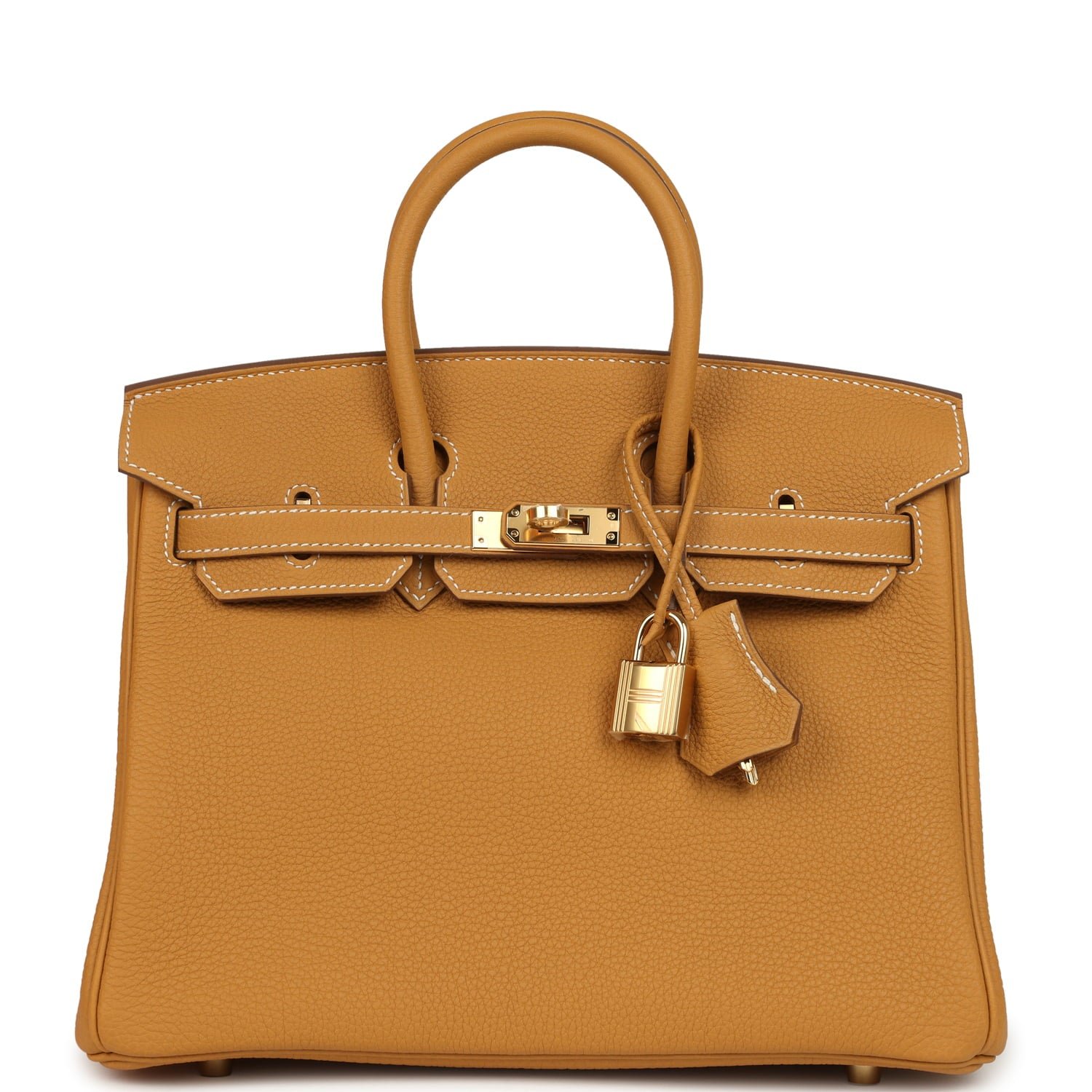
The Hue: Naturel Sable
"Naturel Sable" (Natural Sand) is a breathtaking, sun-kissed neutral that captures the essence of warm, wind-swept dunes. Unlike stark blacks or heavy chocolates, Sable occupies a delicate middle ground between a rich camel and a golden tan. It possesses an organic warmth that complements an extraordinarily diverse spectrum of wardrobes, shifting seamlessly from crisp summer linens and whites to deep cashmere winter coats and tailored wools. Because it is a true neutral, it acts as a chameleon, grounding louder outfits while adding effortless sophistication to monochrome ensembles.
The Hide: Togo Calfskin
The choice of leather defines not only the look of a Birkin but how it feels against the hand and how it ages over time. Togo leather—crafted from young bull calfskin—is widely considered the gold standard for Hermès bags.
The Pebble Texture: Togo is distinguished by its pronounced, irregular grain (known as reproduce or natural pebble) achieved through a process of shrinking the leather.
Scratch and Water Resistance: Unlike smoother leathers like Box Calf or Swift, Togo’s textured surface is exceptionally resilient. It naturally camouflages minor surface scratches and scuffs, making it an ideal canvas for a daily-carry bag.
Structural Memory: Despite its soft, supple hand-feel, Togo possesses a remarkable density. It allows the Birkin 25 to maintain its crisp, rectangular silhouette over decades of use without requiring excessive internal reinforcement. Over time, it develops a luxurious, buttery slouch while retaining its core shape.
The Hardware: Gold-Tone Brilliance
The bag is finished with Hermès’ signature gold-plated hardware (GHW), which includes the iconic plaque, sangles (straps), toggle (turn-lock), feet at the base, padlock, and keys tucked inside the leather clochette. The pairing of gold hardware with Naturel Sable leather creates a tonal, monochromatic harmony. Rather than introducing a sharp metallic contrast (such as palladium), the gold hardware enhances the warm, golden undertones of the Sable hide, emitting an aura of timeless, old-money opulence. Furthermore, contrast white saddle stitching often punctuates the design, drawing the eye to the flawless, hand-executed seams that prove the bag was constructed from start to finish by a single artisan.
3. The Allure of the Birkin 25
While the Birkin 35 was the undisputed queen of the 1990s and 2000s, the Birkin 25 has emerged as the definitive silhouette of the modern era. Measuring roughly 25cm in width, 20cm in height, and 13cm in depth, the 25cm size strikes a brilliant balance between structural presence and effortless portability.
Proportion and Versatility: The smaller scale lends itself exquisitely to hand-carry or crook-of-the-arm styling. It transitions fluidly from a practical daytime companion for errands or business meetings to an elegant, understated statement piece for evening galas and gallery openings.
Weight Management: Because larger leather bags can become heavy when fully loaded, the Birkin 25 offers a lightweight alternative that comfortably houses modern daily necessities—smartphones, cardholders, keys, and cosmetics—without straining the arm.
Market Desirability: In boutique allocation circles and secondary collector markets alike, Birkin 25s in neutral colors are heavily constrained in supply, driving immense demand and making them crown jewels of private collections.
4. The Hermès Craftsmanship Standard
To fully appreciate why a Birkin commands its legendary status, one must look closely at the ateliers of Hermès. No part of the bag is mass-produced.
Every single Hermès Birkin is handcrafted by a single artisan who has undergone years of rigorous training at the brand's leather-working schools in France. The process begins with the careful selection of hides, where imperfections are meticulously avoided. Using traditional saddle-stitching—a technique inherited from the brand's equestrian roots in the 19th century—the artisan uses a two-needle technique with waxed linen thread. Because the needles pass through the same hole from opposite sides, if one thread were ever to break, the structural integrity of the stitch remains uncompromised.
The edges of the leather are meticulously painted, sanded, and sealed with multiple layers of heat-treated resin. The metal hardware is plated with precious metals (such as 18k gold), ensuring that it resists tarnishing and retains its brilliant luster over a lifetime. This uncompromising dedication to time-honored craftsmanship is why an authentic Birkin is treated not merely as an accessory, but as a wearable work of art.
5. Investment Value and Market Performance
Beyond its aesthetic and cultural cachet, the Hermès Birkin has long been studied by financial analysts and luxury economists as an alternative asset class. Numerous studies, including data compiled over decades, have consistently demonstrated that rare Hermès leather goods often outperform traditional stocks, gold, and real estate indices in terms of stability and ROI.
Several factors drive the exceptional secondary market performance of the Birkin 25 in Naturel Sable Togo with Gold Hardware:
Artificial Scarcity: Hermès does not publicly sell Birkins online or stock them openly on boutique shelves. Acquiring one directly from an official boutique requires building a significant "purchase history" (buying ready-to-wear, shoes, fine jewelry, and home goods), making direct retail acquisition a long and costly journey.
The "Hermès Premium": Because boutique access is restricted, secondary market buyers are often willing to pay a premium above original retail pricing for pristine, store-fresh, or gently worn collector pieces that can be obtained immediately without a waiting period.
Neutral Color Resilience: While seasonal or trend-driven colors (such as bright pinks or pastels) can fluctuate with fashion cycles, classic neutral shades like Naturel Sable, Etoupe, Gold, and Noir retain their value exceptionally well because they never go out of style.
6. Caring for Your Naturel Sable Togo Birkin
Owning a piece of high-luxury leather goods requires mindful stewardship to preserve its beauty and structural longevity. Togo calfskin is notably forgiving, but proper maintenance ensures it remains pristine for generations:
Storage: When not in use, the bag should be stuffed with acid-free tissue paper or its original felt insert to maintain its structural shape. It should always be stored in its original flannel dust bag inside its orange Hermès box.
Climate Control: Leather is a natural material sensitive to extreme humidity and temperature fluctuations. Keep the bag away from prolonged direct sunlight (which can alter the Naturel Sable tone) and damp environments to prevent mold or warping.
Hardware Protection: Many collectors choose to keep the protective plastic film on the metal hardware when storing the bag, though removing it for regular wear is a matter of personal preference. Avoid spraying perfumes or hand sanitizers directly near the leather or metal components.
Conclusion
The Hermès Birkin 25 in Naturel Sable Togo with Gold Hardware is far more than a luxury handbag; it is a cultural artifact representing the pinnacle of European craftsmanship, timeless design, and quiet sophistication. From the rich, sunlit warmth of its Sable leather and the resilient pebbled grain of Togo calfskin to the luminous gleam of its gold hardware, every detail works in unison to create an object of enduring desire. For collectors and fashion connoisseurs alike, it remains a crowning achievement—an investment in beauty, history, and uncompromising quality that transcends the fleeting trends of the fashion world.


Comments
Post a Comment