Anatomy of the Hermès Birkin 25 in Blue Jean Togo with Palladium Hardware
Few objects in the realm of fashion command the universal reverence, fascination, and enduring allure of an Hermès Birkin bag. Among the myriad combinations of sizes, leathers, and hardware finishes that have graced the ateliers of Paris over the decades, certain configurations achieve legendary status. One such masterpiece is the Hermès Birkin 25 in Blue Jean Togo leather paired with Palladium Hardware (PHW).
This specific specification merges one of the French luxury house’s most historically beloved and versatile shades with its most coveted modern compact size. To understand why this particular configuration triggers a frenzy among collectors, investors, and style aficionados worldwide, one must explore the convergence of its heritage, material science, color theory, craftsmanship, and economic prowess.
1. The Genesis and Evolution of the Birkin Phenomenon
To fully appreciate the Birkin 25, one must revisit its iconic origins. Introduced in 1984, the Birkin was born out of a fortuitous mid-air encounter on a flight from Paris to London between then-Hermès Chief Executive Jean-Louis Dumas and British actress and singer Jane Birkin. As the story goes, Jane Birkin had placed her straw weekend bag in the overhead compartment, only for its contents to spill out everywhere. She lamented to Dumas that she could not find a leather weekend bag that was both elegant and practical enough to suit her needs as a young mother.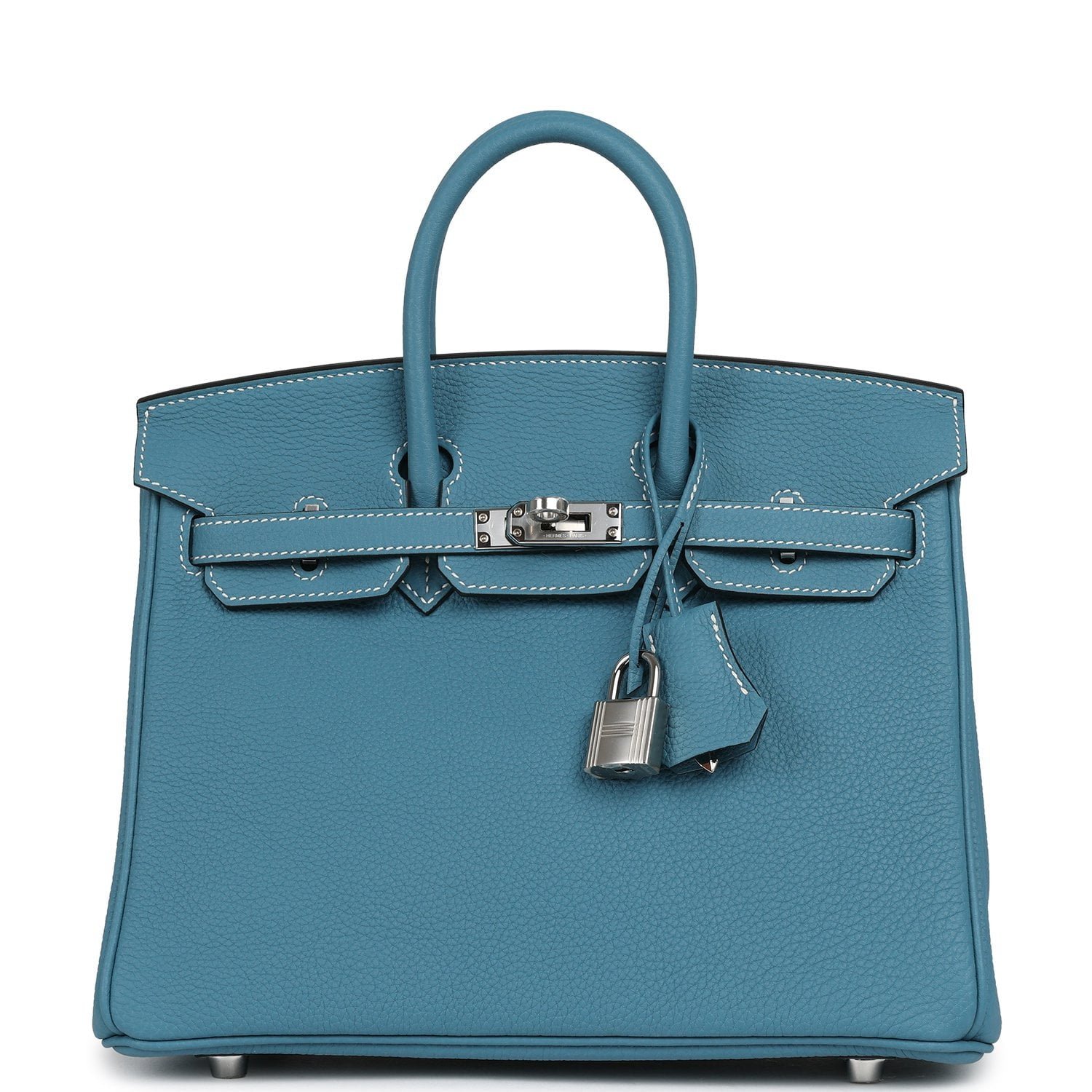
Dumas sketched the blueprint for a supple, spacious carryall right there on the back of a sickness bag. The design featured a rectangular silhouette, two rolled handles, a secure flap closure, sangles (straps), a turn-lock mechanism, and protective feet (clous) on the base.
While the original Birkins favored by Jane herself tended to be larger sizes like the 35cm or 40cm—worn slouchy, heavily personalized, and packed to the brim—the luxury landscape has shifted dramatically over the last two decades. The Birkin 25, introduced later in the brand's timeline, has ascended to the throne of modern desire. Its smaller, daintier proportions align seamlessly with contemporary lifestyle trends, transitioning effortlessly from a chic daytime companion to an elegant evening accessory.
2. Deconstructing the Specification
Every element of the Birkin 25 in Blue Jean Togo with Palladium Hardware represents a deliberate masterclass in design harmony.
The Color: Blue Jean (Bleu Jean)
Few colors in the Hermès pantheon evoke as much nostalgic devotion as Blue Jean. Originally introduced in the late 1990s, Blue Jean is a captivating mid-tone blue infused with distinct, soft grey undertones.
The Versatility of Denim: True to its name, Blue Jean was famously designed to complement denim. It acts as a near-neutral, bridging the gap between casual and formal wear. It possesses a relaxed yet sophisticated disposition that makes it endlessly wearable across all seasons.
Contrast Stitching: Traditional Blue Jean bags are famously accentuated by white contrast stitching (sellier or retourne stitching), which highlights the architectural precision of the bag's construction and adds a crisp, sporty elegance.
The Leather: Togo
Crafted from male calf leather, Togo is widely considered the ultimate gold standard for everyday Hermès bags. Named after the African nation, Togo leather was introduced around 1997 and quickly surpassed older classics like Courchevel and Box calf in popularity.
Texture and Grain: Togo features a prominent, raised, pebble-like grain with a distinct vertical pattern. Running your fingers across the leather reveals a rich, tactile depth.
Durability and Resilience: One of Togo’s greatest strengths is its remarkable resilience. It is naturally scratch-resistant and holds its structure well over time. Unlike smoother leathers that show every minor blemish, Togo can endure daily wear and tear while retaining its luxurious hand-feel. It even handles light moisture and rain surprisingly well.
Weight Profile: Despite being a sturdy leather, Togo is relatively lightweight, ensuring that the Birkin 25 remains comfortable to carry by hand or over the crook of the arm.
The Hardware: Palladium (PHW)
The metal hardware on an Hermès bag is not merely functional; it is jewelry. Palladium belongs to the platinum group of metals.
Aesthetic Appeal: Palladium hardware offers a brilliant, bright, white-silver finish that feels crisp, modern, and youthful compared to traditional gold hardware (GHW).
Durability: Solid brass plated in precious palladium, this hardware is remarkably resistant to tarnishing, oxidation, and everyday scratching. Against the dusty, casual brightness of Blue Jean Togo leather, palladium hardware creates a cohesive, cool-toned harmony that is breathtaking to behold.
3. The Anatomy and Dimensions of the Birkin 25
Measuring approximately 25 cm in width, 20 cm in height, and 13 cm in depth (roughly 10 x 7.5 x 4.75 inches) with a handle drop of about 7 cm, the Birkin 25 is an architectural marvel.
Interior Organization: The bag is lined with supple Chèvre (goat skin) leather—often matching the exterior Blue Jean shade. It features a spacious main compartment, a zippered pocket on one side equipped with an Hermès-engraved zipper pull, and an open slip pocket on the opposite wall.
Capacity: While compact, the Birkin 25 comfortably accommodates modern daily essentials: a smartphone, a compact cardholder or wallet, keys, lipstick, and small daily necessities.
Carrying Style: Because of the handle drop dimensions, the Birkin 25 is primarily designed to be carried gracefully in the hand, on the wrist, or over the forearm. For those with very petite frames, it can sometimes slip over the arm, but it is predominantly styled as a handheld statement piece.
4. The Hermès Craftsmanship Philosophy
To understand why a Birkin commands a multi-thousand-dollar price tag and extensive waitlists, one must look at the production model. Unlike mass-produced luxury goods, every Hermès Birkin is constructed from start to finish by a single artisan.
Training as an Hermès leather artisan takes years of rigorous apprenticeship. The artisan selects the skin, cuts the pieces using specialized tools, treats the edges, and stitches the bag entirely by hand using the traditional saddle-stitching technique—a dual-needle method where two needles pass through the same hole in opposite directions. This ensures that even if a thread were to break over time, the structural integrity of the stitch remains uncompromised.
A single Birkin requires anywhere from 18 to 25 hours of continuous labor. Hidden inside the internal flap of the bag lies a subtle heat stamp—consisting of a cipher, letter, or shape code—that denotes the specific artisan, the workshop, and the year of manufacture. This transforms each bag from a consumer product into a piece of signed, wearable fine art.
5. Market Position, Investment Value, and Rarity
Purchasing a Birkin directly from an Hermès boutique is notoriously difficult. Due to strict production limits and corporate policies designed to curb speculative buying, clients cannot simply walk into a store and purchase a Birkin off the shelf. Instead, they must cultivate a long-term relationship with a sales associate, purchasing secondary items (such as ready-to-wear, shoes, fine jewelry, and home goods) to build an established purchase history before being offered the "quota bag" of their dreams.
Because of this scarcity, the secondary resale market for Hermès Birkins is hyper-active and financially robust. Major auction houses like Sotheby's, Christie's, and elite luxury curators trade millions of dollars in Birkins annually.
The Blue Jean Premium: While neutral colors like Black, Gold, and Etoupe traditionally hold the highest baseline demand, iconic heritage colors like Blue Jean command intense loyalty. Because Hermès frequently rotates its color palette, archiving and reviving colors years later, vintage or pristine-condition Blue Jean pieces—especially in the hyper-popular 25cm size—frequently command strong premiums well above their original retail prices on the secondary market.
An Alternative Asset Class: Financial analyses over the years have consistently shown that rare Hermès leather goods often outperform traditional stock markets or gold indices in terms of value retention and appreciation. A pristine Birkin 25 in Togo with palladium hardware is treated by savvy collectors not just as a fashion accessory, but as a liquid, tangible asset.
6. Conclusion
The Hermès Birkin 25 in Blue Jean Togo with Palladium Hardware is far more than an expensive handbag. It represents the absolute pinnacle of heritage leathercraft, color theory, and understated luxury. By blending the relaxed, casual charm of Blue Jean Togo leather with the crisp, modern brilliance of palladium hardware, and scaling it into the coveted 25cm format, Hermès created an eternal classic.
Whether worn casually with a simple white T-shirt and vintage jeans or paired with haute couture for an evening gala, it remains a testament to timeless design—a quiet icon that whispers luxury rather than shouting it.


Comments
Post a Comment