A Comprehensive Guide to the Hermès Birkin 25 in Bleu Nuit Togo with Palladium Hardware
In the upper echelons of the luxury fashion ecosystem, few items command the immediate reverence, cultural cachet, and enduring financial value of an Hermès Birkin. Born out of a legendary 1984 mid-air encounter between actress Jane Birkin and Hermès Chief Executive Jean-Louis Dumas, the Birkin bag has transformed from a practical carryall for a young mother into an international symbol of exclusivity.
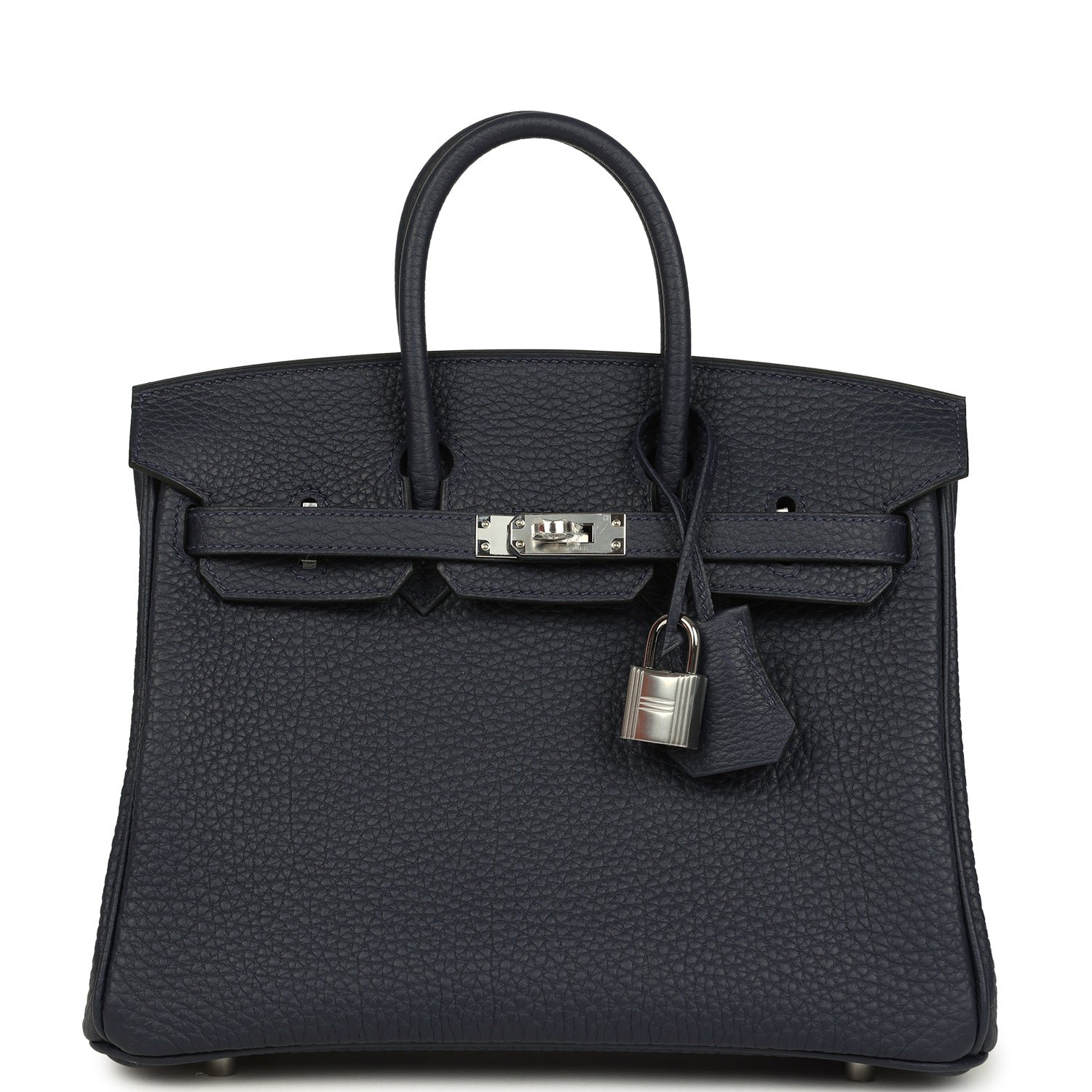
Among the vast constellation of sizes, leathers, and colors released by the historic Parisian fashion house over the decades, specific combinations achieve a legendary status among collectors. One such masterpiece is the Hermès Birkin 25 in Bleu Nuit Togo Leather with Palladium Hardware. This configuration represents a masterclass in understated elegance—fusing the coveted miniature proportions of the Birkin 25, the legendary durability of Togo leather, the chameleon-like depth of Bleu Nuit, and the crisp modernity of palladium.
1. Anatomy of an Icon: The Allure of the Birkin 25
When the Birkin was first introduced, larger sizes such as the Birkin 35 and 40 dominated the landscape, favored for their spacious utility. However, over the past decade, a major shift in consumer preference has propelled the Birkin 25 to the forefront of global demand.
Measuring roughly 25 cm in width, 20 cm in height, and 13 cm in depth, the Birkin 25 is celebrated for its petite, jewel-like proportions. While it cannot accommodate a standard laptop, it easily houses modern daily essentials—including a smartphone, cardholder, keys, lipstick, and compact essentials.
Its smaller scale completely alters the character of the bag. It transforms the utilitarian workhorse into an effortlessly chic day-to-evening accessory. Whether carried gracefully by the double rolled handles or worn suspended from the crook of the arm, the Birkin 25 strikes a definitive chord with contemporary collectors who value refined elegance over oversized convenience.
2. The Materiality: Togo Leather and Its Resilient Legacy
To understand the appeal of an Hermès bag, one must appreciate the meticulous craftsmanship behind its materials. The Birkin 25 in question is crafted from Togo leather, one of Hermès’s most famous and historically sought-after hides.
Introduced to the brand in 1997 and named after the African country, Togo leather is derived from baby calfhide. It is distinguished by several key characteristics:
The Grain: Togo features a prominent, natural round grain (known as venin) that is tumbled to achieve a soft yet resilient texture.
Structure and Slouch: Unlike more rigid box calfskins or ultra-supple Swift leathers, Togo strikes a brilliant middle ground. It possesses a natural stiffness that allows the bag to maintain its crisp architectural silhouette over decades of use, yet it develops a subtle, relaxed slouch over time.
Scratch and Water Resistance: Because of its textured grain, Togo is remarkably forgiving. It resists everyday scuffs, minor scratches, and moisture far better than smooth leathers, making it an ideal choice for a daily-rotation luxury bag.
Inside the bag, the lining shifts to smooth Chèvre leather (goatskin), matching the exterior tone. Chèvre is prized for its lightweight nature, durability, and a distinct fine grain that feels exquisitely soft to the touch.
3. Color Theory: The Mystique of Bleu Nuit
Color naming at Hermès is an art form in itself, and Bleu Nuit (French for "Night Blue") is widely considered one of the maison’s most sophisticated dark neutrals.
At first glance in dim lighting, Bleu Nuit can easily be mistaken for classic Noir (black). However, under direct sunlight or bright indoor illumination, the color reveals its true complexity: a deep, rich, nocturnal navy blue with subtle undertones of midnight ocean depths.
For collectors who find standard black accessories too stark or severe, Bleu Nuit offers the ultimate alternative. It pairs seamlessly with almost any wardrobe palette—anchoring winter coats in charcoal and camel just as effortlessly as it complements summer linens in white and beige. It is a chameleon color that whispers rather than shouts, perfectly aligning with the modern global aesthetic of "quiet luxury."
4. The Hardware Contrast: Palladium (PHW)
The choice of hardware on an Hermès bag dictates its overall personality. While gold hardware (GHW) imparts a warm, vintage-inspired opulence, Palladium Hardware (PHW) introduces a crisp, contemporary, and minimalist edge.
Palladium is a rare, lustrous silvery-white metal belonging to the platinum family. Highly resistant to tarnishing and corrosion, it provides a striking, clean contrast against the deep, dark expanse of Bleu Nuit Togo leather. The bright metallic flash of the signature Hermès turn-lock, sangles, plaque, and base feet (clou) catches the light brilliantly, emphasizing the flawless geometry of the bag's construction.
5. Craftsmanship and the Hermès Philosophy
Every Hermès Birkin is a testament to slow fashion in a world obsessed with instant gratification. A single bag is constructed entirely by hand by a single artisan in the Parisian workshops, a process that takes a minimum of 18 to 20 hours of intense labor.
The artisan uses the signature saddle stitch—a technique utilizing two needles and waxed linen thread that ensures if one stitch is somehow broken, the rest of the seam will never unravel. From the hand-painted edges (filet) to the tiny blind stamp hidden beneath the strap (denoting the artisan's identification code and production year), every detail represents the pinnacle of French leather goods heritage.
6. Market Position and Investment Value
Acquiring a Birkin directly from an official Hermès boutique is notoriously difficult. Due to strict production caps and allocation policies, boutiques receive limited shipments twice a year, and clients must build a significant "purchase history" (buying ready-to-wear, shoes, fine jewelry, and home goods) before being offered the opportunity to purchase a quota bag.
Because of this scarcity, the secondary and primary resale markets for pristine-condition pieces command substantial premiums. The Hermès Birkin 25 in Bleu Nuit Togo with Palladium Hardware sits comfortably as a blue-chip asset in the secondary market. Store-fresh examples complete with full sets—including the orange box, dust bag, clochette, lock, keys, and original protective plastics—frequently trade well above their original retail prices. Unlike traditional financial instruments, a Birkin allows its owner to wear and enjoy their investment while historical data points toward steady long-term appreciation.
Conclusion
The Hermès Birkin 25 in Bleu Nuit Togo with Palladium Hardware is far more than a mere luxury handbag. It is a harmonious intersection of heritage, utility, and timeless design. By uniting the most desirable size format in contemporary fashion with a color as deep as the night sky and hardware that gleams with modern precision, this piece captures the very soul of Hermès. For the discerning collector, it remains an enduring trophy of elegance that will never go out of style.


Comments
Post a Comment